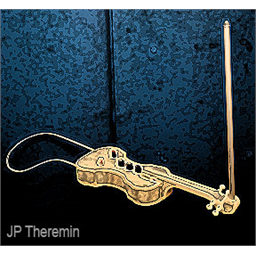
Hi everyone! Thanks for all the input. Sorry I always end up responding a few days late, but since this forum has been integral to me building this thing I figure I owe it a report afterward xD
JPascal: Indeed it is a circuits lab, but this is not a group project. I just wanted to build an analog theremin
Dewster: Good call on the insulation. I ended up soldering them on protoboards/stripboards (whatever the ones with the connected TH holes are called)
ILYA: Not sure on the resistances, the coils installed are Bourns RL181S-102J-RC
In summary, I have had a very long and arduous journey trying to replicate this build: http://www.thereminworld.com/Article/14695/a-diy-wine-box-theremin. The comments mention the LC filter after the volume antenna is incorrect (it is) but I also could not get the pitch oscillators to go above ~160kHz, which was giving me a horrible pitch field of like 300Hz. I found out the LC tank was resonating with the emitter capacitor as well (which I thought was just a bypass) and the feedback cap was way too high. These values give me a pretty good pitch field:
270pF capacitor for feedback
1nF capacitor for emitter to ground
~100pF capacitor for variable pitch, and about ~40pF + a variable cap for reference pitch
Maybe I'll make my own post after how much suffering this thing has caused me. Currently my biggest problems are bad soldering, the oscillators locking at low frequencies (I really need to add buffer stages between the oscillators and the mixer) and this low, raspy sound at low frequencies, which might be unregulated power supply? No idea.
Again, thank you all for your infinite patience. Some keywords in case anyone who needs this in the future can find it: Jason, 2013, wine box theremin, frequency too low, SRF